
ADVERTISEMENT
The Food Safety Reality Check We All Need
Here’s what the food safety specialist told me that actually made me feel better.
ADVERTISEMENT
“We’ve trained consumers to expect that meat looks like a plastic-wrapped rectangle of identical pink slices. But meat comes from animals. Animals have body parts. Sometimes those body parts end up in the package. That’s not a safety failure—it’s a reality check.”
She wasn’t being dismissive. She was being honest.
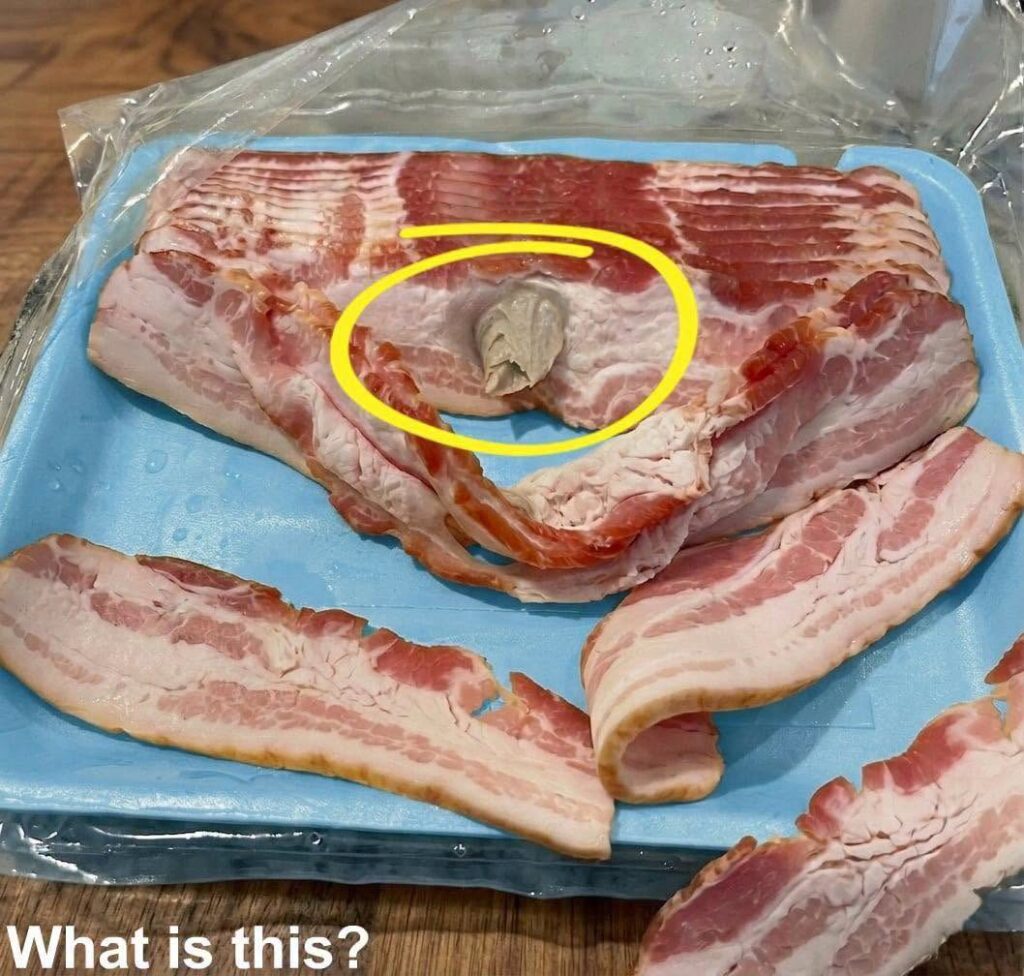
The meat industry does an incredible job of making products look uniform. But no pig is perfectly uniform. No cow is perfectly symmetrical. When you buy bacon, you’re buying slices of an animal’s belly. And bellies have lymph nodes, glands, and connective tissue. Most of these are removed during processing, but occasionally one slips through.
It’s not dangerous. It’s not a sign of poor quality. It’s just… real.
When to Actually Worry (A Practical Food Safety Guide)
Okay, so a random pale chunk isn’t a crisis. But that doesn’t mean you should ignore every oddity in your food. Here’s a quick decision tree for the next time you open a package and something looks off.
Perfectly normal (don’t panic):
Pale, firm, bean-shaped lumps (lymph nodes)
Small, lobed, pale pieces (mammary tissue)
Dense, rubbery white bits (connective tissue)
Dark spots on bone-in meat (blood from processing)
Pay attention (but still probably fine):
Greenish or iridescent sheen on cooked bacon (this is actually light reflecting off fat and nitrates—completely harmless)
White, chalky spots on frozen meat (freezer burn—safe to eat but tastes dry)
Slight discoloration on the edges of packaged meat (oxidation—trim and cook promptly)
Stop and inspect (could be spoilage):
Sticky or slimy texture on fresh meat (bacteria growth)
Strong, sour, or ammonia-like smell (spoilage)
Green or black mold (not the fancy cheese kind)
Bloated, puffy packaging (gas from bacterial growth)
Throw it away immediately (no debate):
Any sign of broken seals or tampering
Meat that’s been left at room temperature for more than 2 hours
Canned goods that are bulging, leaking, or rusted
Healthy Eating Tips for Confident Meal Prep
One of the reasons I panicked over that bacon chunk is that I take food safety seriously. I meal prep. I pack lunches. I feed my family. The idea that something “wrong” could slip into my kitchen felt like a personal failure.
But here’s what I’ve learned: being a smart cook isn’t about never encountering weird things in your food. It’s about knowing how to respond when you do.
Tip #1: Learn what normal looks like.
The more you cook with whole cuts of meat—chicken thighs with skin, pork shoulder, beef brisket—the more familiar you’ll become with the natural variations in animal products. Grocery stores hide this from you by selling only perfect, uniform pieces. But perfect isn’t natural. Natural is messy.
Tip #2: Trust your nose more than your eyes.
Your eyes will lie to you. Discoloration can be oxidation. Iridescence can be light refraction. But your nose? Your nose knows. Spoiled meat has a distinct sour, sickly smell that you will recognize immediately. If it smells fine, it’s almost certainly fine.
Tip #3: When in doubt, cook it thoroughly.
Most foodborne pathogens die at 165°F (74°C). If you’re worried about something you’ve found in your meat, cook it to a safe internal temperature. That weird bacon chunk will crisp right up. That suspicious spot on your chicken breast will be indistinguishable after roasting.
Tip #4: Keep a “food curiosity” journal.
I’m not kidding. When you find something odd in your food, take a picture. Look it up later. Ask your butcher or grocery store meat counter. Over time, you’ll build a mental library of what’s normal and what’s not. Knowledge kills panic.
Smart Meal Prep Awareness: 5 Rules I Live By
After my bacon incident, I got serious about kitchen food safety. Not paranoid—just prepared. Here are the rules I follow now.
1. Thaw meat in the refrigerator, never on the counter.
This is the #1 mistake home cooks make. A frozen chicken left on the counter for 4 hours develops a temperature “danger zone” (40°F–140°F) where bacteria multiply like crazy. Plan ahead. Thaw in the fridge overnight.
2. Use separate cutting boards for meat and produce.
Cross-contamination is real. I have a red cutting board for meat, a green one for vegetables, and a yellow one for cooked foods. Cost me fifteen dollars. Saved me from at least one mystery stomach bug.
3. Cook to temperature, not to time.
Get a digital meat thermometer. They’re ten bucks. Cook chicken to 165°F, pork to 145°F (with a three-minute rest), ground beef to 160°F. Time is a guess. Temperature is a fact.
4. The 2-Hour Rule is non-negotiable.
Perishable food left at room temperature for more than 2 hours goes in the trash. Not the fridge to “save for later.” Not “just a taste.” Trash. At 4 hours, bacteria can double every 20 minutes. Don’t play that game.
5. When meal prepping, cool food quickly before refrigerating.
Hot food in a closed container in the fridge can stay in the danger zone for hours. Spread hot food into shallow containers, leave lids cracked until cool, or use an ice bath. Then refrigerate.
What the Bacon Company Told Me (And Why It Helped)
I did end up calling the customer service number on the bacon package. The representative was kind, calm, and clearly used to panicked calls from people like me.
She asked me to describe the chunk. Color? Pale. Texture? Firm and rubbery. Size? About an inch long. Location? Between slices, not attached to the meat.
“Oh,” she said, “that’s just a lymph node. Happens sometimes. You can cut it off if it bothers you, but it’s perfectly safe to eat. Would you like me to mail you a coupon for a free package?”
I said yes to the coupon. I also asked her how often people call about this.
“Every single day,” she said. “Usually around holiday weekends when people are cooking for company. You’d be amazed how many people think they’ve found a tumor or a worm or something. It’s almost always a lymph node.”
She told me that if more people understood basic meat anatomy, they’d save themselves a lot of stress. So that’s what I’m trying to do here.
Frequently Asked Questions About Strange Food Finds
Can you eat a lymph node?
Yes. It’s just tissue. It might be chewy or dense, but it’s not harmful. Some cultures consider lymph nodes a delicacy (though I personally cut them off for texture reasons).
What about the iridescent rainbow sheen on sliced deli meat or cooked bacon?
That’s called structural color. It happens when light reflects off the fat and protein layers. It’s not mold, not chemicals, not a sign of spoilage. It’s physics. Eat without fear.
Is freezer burn dangerous?
No. Freezer burn is dehydration—those white, icy patches mean the meat has lost moisture. It’ll taste dry and sad, but it won’t hurt you. Trim the affected areas before cooking.
What if I already ate the weird chunk before I noticed it?
You’ll be fine. Hundreds of thousands of people eat lymph nodes and glandular tissue every day without knowing it. Your body doesn’t care. Your brain might feel weird about it, but your stomach won’t notice.
Should I return the product to the store?
You can. Most grocery stores will refund or replace any product you’re unhappy with, no questions asked. But don’t do it out of fear—do it because you want your money back for an unpleasant experience.
How can I avoid this in the future?
You can’t entirely. Meat comes from animals. Animals have body parts. The more you cook whole cuts, the more you’ll see natural variation. If it truly bothers you, processed meats like sausage or ground meat are more uniform. But even those aren’t 100% predictable.
A Final Thought (From Someone Who’s Been There)
I almost threw away that entire package of bacon. I was that grossed out. I was that convinced something was wrong. But instead, I took a breath, did some research, and learned something valuable.
That weird bacon chunk didn’t mean my food was unsafe. It meant my expectations were unrealistic.
We want our food to look like it does in commercials—perfect, uniform, almost artificial. But real food isn’t artificial. Real food comes from real animals with real body parts. And sometimes those body parts show up uninvited between your bacon slices.
It’s not a failure of the food system. It’s a reminder that the food system is made of farms and animals and butchers, not magic and plastic wrap.
So next time you open a package and find something unexpected, don’t panic. Take a picture. Do a quick search. Ask someone who knows. And remember that a little knowledge goes a long way toward keeping your kitchen safe, your family healthy, and your breakfast exactly as delicious as you planned.
Now go cook that bacon. Weird chunk or not, breakfast is waiting. 🥓
ADVERTISEMENT